Accelerating Net Zero Flight: A Year of Impact with DESNZ and the Aviation Impact Accelerator
With generous funding from the UK Department for Energy Security and Net Zero (DESNZ) from July 2024 to June 2025, the AIA has advanced the UK’s global leadership in aviation decarbonisation. The funding enabled critical systems modelling, agile policy support, and international collaboration, and we look forward to working with UK policymakers further next year.
The objectives of the grant were to establish world-leading modelling capability, to support Government via agile policy sprints, and to demonstrate UK leadership in net zero aviation on a global stage.
Deliverables
Key deliverables of this grant were to deliver:
- Integrated models for airport transition, airline operations, and land use
- Three policy sprints (SAF Revenue Certainty Mechanism, Operational Efficiency, Marginal Abatement Costs)
- Global leadership initiatives including publication of the 2030 Sustainable Aviation Goals report, leading events on the global stage at COP29, and the Transatlantic Strategic Aviation Partnership (TSAP).
Modelling and policy support
The AIA’s modelling framework
The AIA’s integrated system-of-systems modelling connects all parts of the aviation value chain to evaluate opportunities and trade-offs. Key areas of development included:
- Airport transition model: Assesses infrastructure needs and lifecycle implications for alternative fuels such as hydrogen and SAF
- Fleet model: Evaluates emissions, cost, and fuel efficiency across aircraft types and scenarios
- Land use model: Analyses global biomass availability and allocates it across sectors under different sustainability constraints
Policy sprints
The AIA delivered three rapid, agile eight-week policy sprint projects which provided tailored insights to UK Government departments.
- Sustainable Aviation Fuels (SAF) Revenue Certainty Mechanism (RCM)
- Techno-economic modelling of SAF production routes (HEFA, gasification, alcohol-to-jet)
- Informed design of t RCM by highlighting risks, costs, and co-product revenue sensitivity
Operational efficiency
- Assessed fuel-saving measures across 35 UK origin airports and 103 destination airports
- Identified that short-haul routes benefit from ground-based efficiencies, while long-haul flights benefit from in-air optimisations
Marginal abatement cost curves
- Created cost curves for sustainable aviation technologies under various future scenarios
- Found that operational efficiency and low carbon aviation fuels are currently the most cost-effective decarbonisation options
Global leadership and strategic influence
Sustainable Aviation Goals: the AIA’s Flagship Report
Launched in September 2024, AIA’s “Five Years to Chart a New Future” report set out four Sustainable Aviation Goals for action by 2030:
- Operation Blue Skies – Contrail avoidance to reduce non-CO₂ climate impacts (up to 40% potential reduction of aviation’s total climate impact)
- Systems Efficiency – Unlocking systems-wide efficiencies in aircraft operations and infrastructure
- Truly Sustainable and Scalable Fuel – Aligning SAF production with biomass constraints and renewable energy capacity
- Moonshots – Demonstration of transformative technologies (e.g., hydrogen, methane fuel systems)
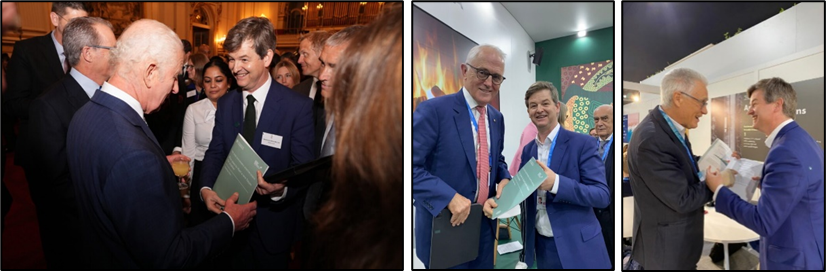
This internationally acclaimed report was launched with support from HM King Charles III’s Sustainable Markets Initiative and widely cited across media and industry conferences.
Transatlantic Strategic Aviation Partnership (TSAP)
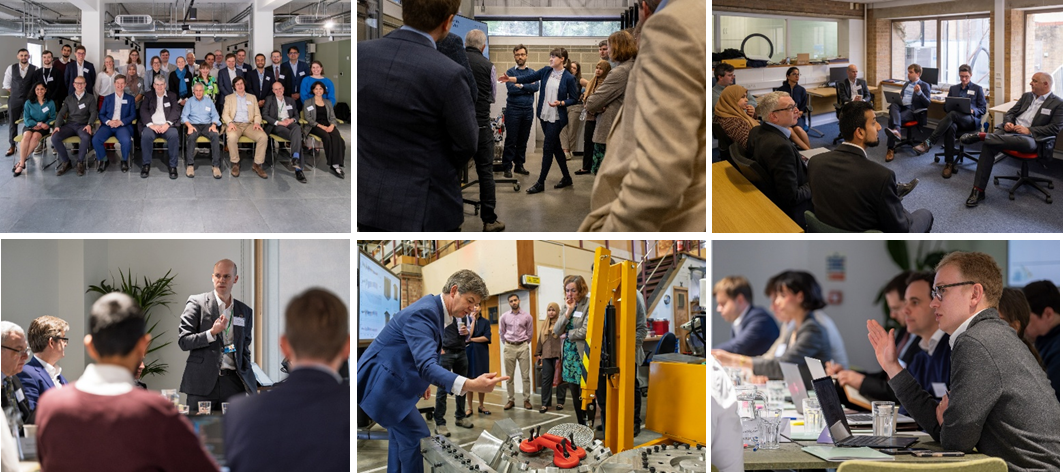
Co-led with MIT, TSAP unites academic experts and government officials from the UK, US, and EU. The second workshop (April 2025, Cambridge) defined four strategic focus areas, building on the four Sustainable Aviation Goals:
- Cryogenic fuels (methane, hydrogen)
- Air traffic control efficiency and contrail avoidance
- Innovative business models in aviation
- Carbon removals and sector-wide trade-offs
For further detail, read the write-up from the workshop.
COP29 & Global Engagement
Cambridge Institute for Sustainability Leadership.
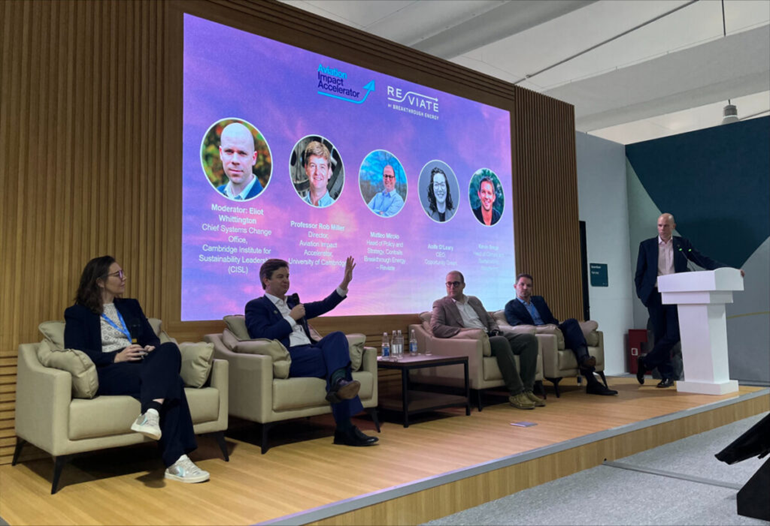
At COP29, AIA co-hosted a landmark cross-sector contrail event with Breakthrough Energy and Google. The session called for large-scale airspace demonstrator trials by COP30, reflecting growing consensus on tackling contrails as a near-term priority.
Supporting policy, industry, and public engagement
Jet Zero Council & AG4
The AIA played a key role in the Government’s Jet Zero Taskforce and led expert analysis for Action Group 4 (AG4) on non-CO₂ impacts. The forthcoming AG4 report, authored by AIA, will inform UK policy on contrail avoidance.
Parliamentary evidence
AIA submitted written and oral evidence to the Environmental Audit Committee’s inquiry on airport expansion. Professor Rob Miller’s testimony received wide public and political engagement. Read the write-up here.
Immersive CEO experience
As part of the Sustainable Markets Initiative, AIA hosted CEOs across sectors at the Whittle Lab, including hands-on demonstrations and contrail capture experiments to build cross-industry awareness of aviation decarbonisation.
Electric aviation demonstration
AIA participated in Cambridge’s first electric flight using the Pipistrel Velis Electro aircraft, raising awareness of zero-emissions flight potential and informing future short-haul strategies. Read more here.
Outcomes and impact
- Modelling excellence: Established a flexible, scalable and internationally respected modelling system for aviation decarbonisation
- Government influence: Informed key UK policy on SAF, operational measures, and investment mechanisms
- International reach: Raised UK’s profile via global partnerships, a landmark report, and global events
- Cross-sector engagement: Connected aviation transition goals with industry, academia, government, and the public
Looking Ahead
The work funded by DESNZ has laid the foundation for systemic aviation decarbonisation. AIA will continue to build on this progress by deepening international cross-sector collaboration, refining modelling tools, and operationalising its 2030 goals across sectors.
The next critical step: converting knowledge into coordinated action—especially around contrail mitigation, SAF investment, and transformative technologies and systems innovation. With continued support, the UK can retain its strategic leadership in enabling a climate-neutral aviation future.
Thank you to the Department for Energy Security and Net Zero for your support.