Reducing climate impact through contrail avoidance
A new study published in Nature Communications by Dr Jessie Smith from the Aviation Impact Accelerator highlights the potential climate benefits of changing aircraft trajectories to avoid persistent contrails.
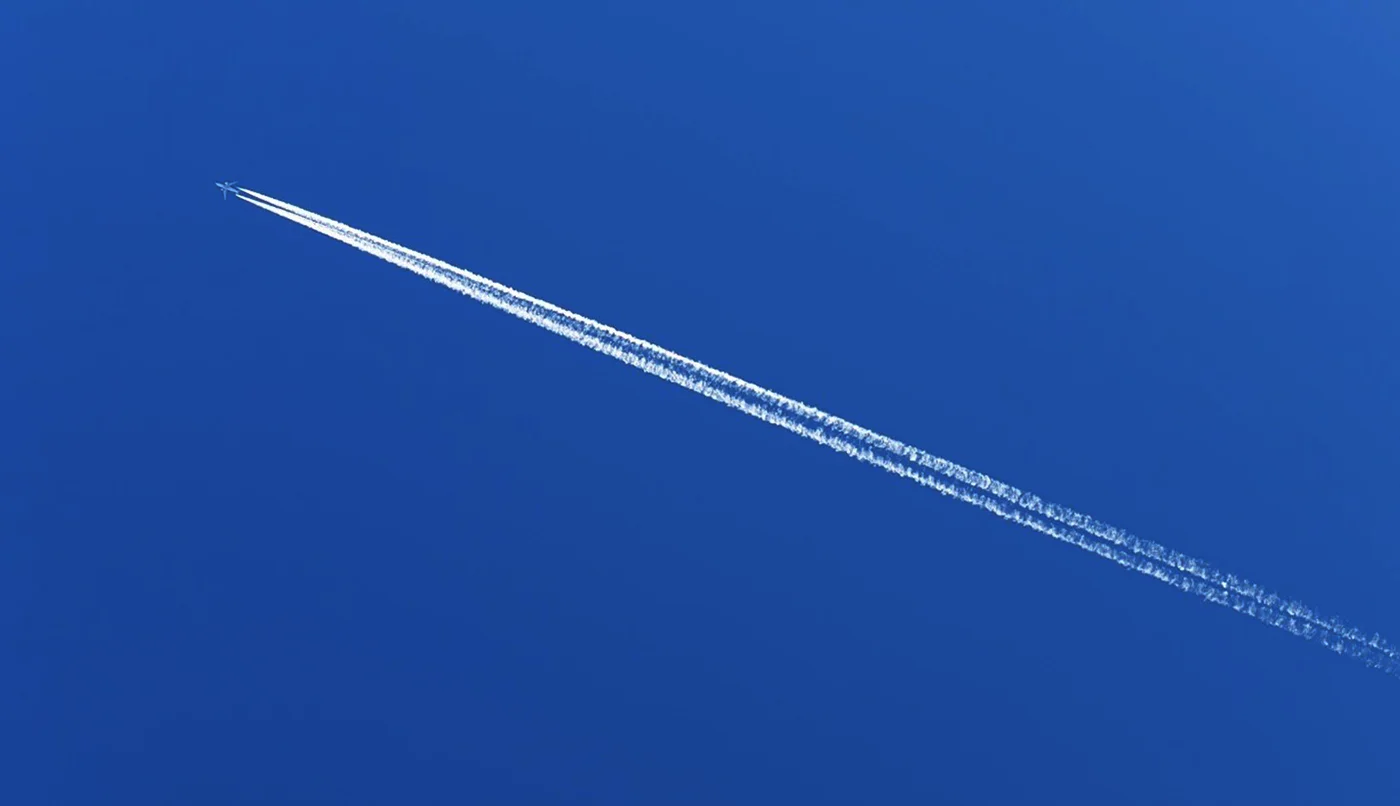
What are contrails?
Contrails — short for condensation trails — are clouds of ice that are formed behind aircraft at cruising altitudes. They trap heat in the atmosphere and contribute to aviation’s non-CO₂ climate impact.
About the study
The study evaluates the potential climate benefit of navigational contrail avoidance, a term used to describe small adjustments to the route or altitude of aircraft to avoid regions where persistent contrails are likely to form.
The research uses reduced order climate modelling to assess aviation’s warming impact to 2050, and finds that contrail avoidance could provide rapid climate benefits, particularly if it is implemented early.
Key findings
- Large near-term climate impact of aviation: Aviation CO₂ and contrails together could account for about 19% of the remaining temperature margin to the +2°C climate limit in 2050.
- Avoidance could recover part of the global temperature budget: a strategy phased in between 2035–2045 could recover around 9% of the remaining warming budget.
- The benefits far outweigh the fuel penalty: While small route deviations may increase fuel burn slightly, the resulting CO₂ increase is expected to be two orders of magnitude smaller than the avoided contrail warming.
- Delay carries climate costs: Postponing contrail avoidance by ten years could reduce its effectiveness dramatically and increase global temperatures in 2050. For every year of delay, the world will be on average 0.003 K hotter in 2050.
Why this matters for aviation climate strategy
Contrail avoidance is increasingly viewed as a practical near-term mitigation measure that can complement longer-term decarbonisation strategies such as sustainable aviation fuels, operational efficiency improvements, and new propulsion technologies. Ongoing work at the AIA is modelling persistent contrail formation under different scenarios (such as time of day/year, aircraft type, location) to inform decision making on the most effective policy and operational strategies for contrail avoidance.
Because contrail impacts occur over much shorter timescales than CO₂ emissions, mitigation measures targeting contrails could deliver faster climate benefits while deeper structural transitions in aviation are developed and scaled.
The study highlights that early contrail avoidance action could play a key role in reducing aviation’s overall climate impact.
The full paper is available here.
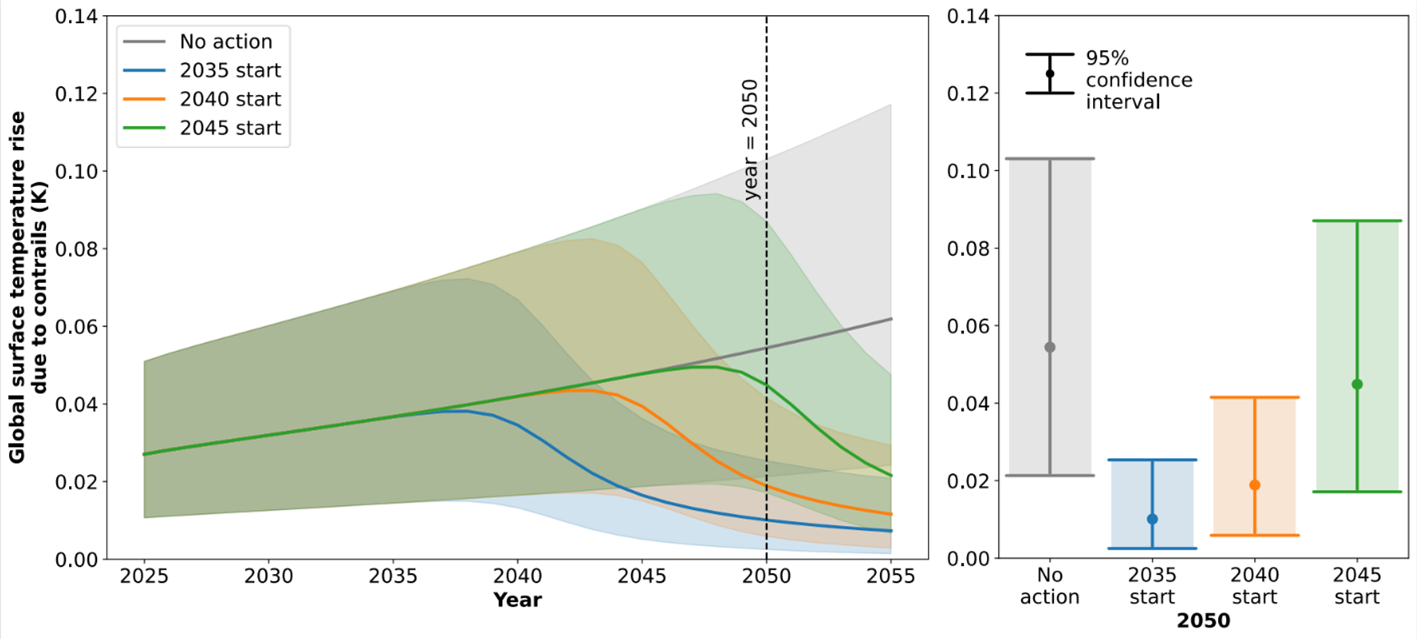
The global surface temperature rise due to contrails, for contrail avoidance scenarios with different start dates.